SEO for Small Businesses in Dubai: What Actually Matters

in this post
SEO for a small business in Dubai comes down to three things: showing up on Google Maps when someone nearby searches, having a page on your website for each thing people actually search for, and giving Google reasons to trust you, mostly reviews and consistency. Everything else is detail. This guide walks through what to fix first, what to ignore, what it costs, and how long it takes.
I’m a website designer and SEO expert in Dubai, and I do this work myself for small businesses, so this is written from the doing, not from a textbook.
Why SEO works differently for small businesses in Dubai
Most SEO guides are written for companies with content teams and global audiences. If you run a clinic in JLT, a salon in Marina, a consultancy in Business Bay or a café in Jumeirah, almost none of that applies to you.
Three things make Dubai different.
People search by neighbourhood.
Nobody looks for "a dentist in Dubai". They search "dentist near me" or "dentist JLT", usually on their phone, usually while already deciding. Google knows where they're standing. That means you're not competing with every dentist in the city, only the ones near you, and only for the searches that mention your area or your service.
Google Maps decides more than the website does.
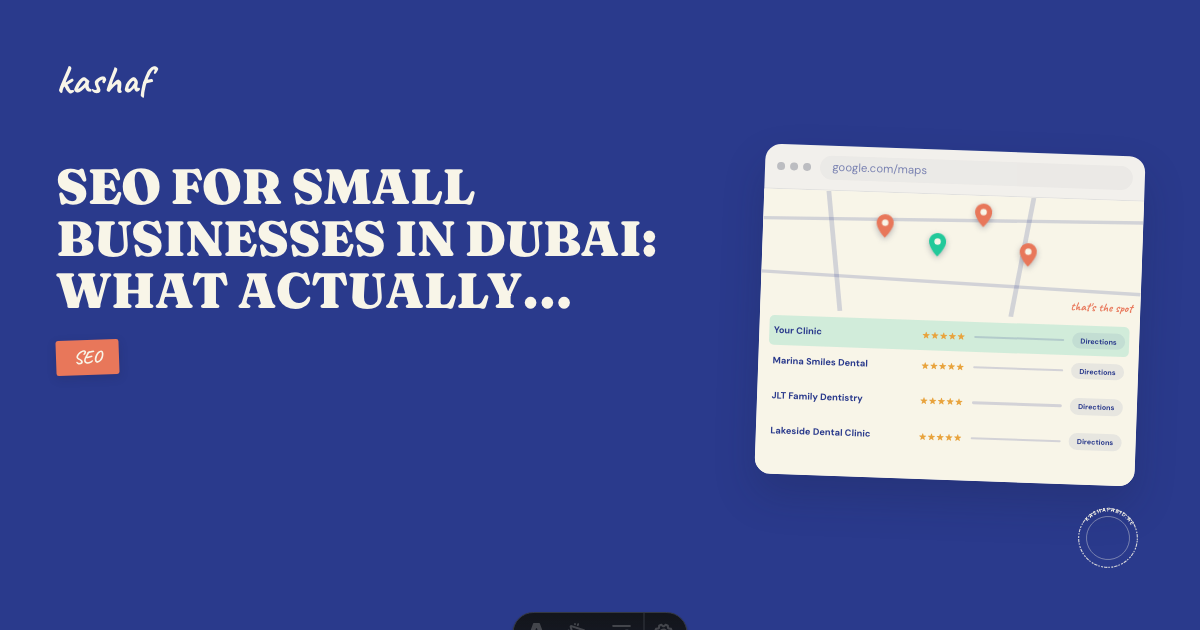
For local searches, Google shows a map with three businesses before the normal results. Most people choose from those three. Getting into that box is more about your Google Business Profile than your website, which is good news, because the profile is faster to fix.
The competition is often weaker than it looks.
Dubai has a lot of businesses with beautiful websites that were never set up to be found. A half-filled Google profile, one vague homepage, no reviews in a year. If that's your competitor, you don't need to outspend them. You need to do the basics properly.
What to fix first: the order that works
I’d do these in this order, because each one builds on the last.
1. Your Google Business Profile
This is the listing that appears on Maps and in the panel on the right of a search. For a small business in Dubai, it’s the single biggest SEO lever you have, and it’s usually the most neglected.
Claim it if you haven’t. Then fill in everything: the right primary category, secondary categories that actually bring searches, a description in the words customers use, services, opening hours, service areas, attributes, booking links and photos. Make sure your business name, address and phone number match exactly what’s on your website and everywhere else online.
Then keep it alive. Add photos, post occasional updates, reply to reviews. Google notices profiles that are looked after.
If you don’t have a physical shop, you can still do this. Google lets you set up a service-area business that shows the areas you cover without showing your home address. Most mobile trainers, cleaners, tutors and consultants in Dubai should be doing this and aren’t.
I cover the full setup on my local SEO in Dubai page.
searching "dentist JLT"
that's the spot
2. Reviews, recent and real
Reviews are the biggest trust signal Google has for a local business. You don’t need hundreds. You need recent ones, honest ones, and replies.
Make it easy: a direct review link, a QR code at the counter or on the invoice, and a short message you send after a visit. Reply to every review, including the bad ones, calmly and in your own voice. A thoughtful reply to a bad review is read more than the review itself.
Don’t buy reviews or write your own. Google is good at spotting it, and a suspended profile is far worse than a slow start.
3. A page for each thing people search for
Here’s the mistake I see on most small business websites in Dubai: one homepage that tries to say everything, and no page that says one thing clearly.
Google ranks pages, not websites. If someone searches “laser hair removal Marina” and your only page is a homepage that mentions laser among twelve other services, Google has nothing specific to show them. Your competitor with a dedicated laser page wins, even if your clinic is better.
So list your main services, find out what people actually type when they look for each one, and give each one its own page. Written properly, in plain language, answering the obvious questions: what it is, who it’s for, what it costs, how to book.
You don’t need twenty pages. Four or five real ones beat twenty thin ones, and Google ignores the thin ones anyway.
4. The words, not just the design
This is the part most agencies skip, and it’s the part I care about most. Your pages need to use the words your customers use, not the words your industry uses.
A clinic writes “aesthetic dermatology”. A customer types “skin doctor”. A consultant writes “bespoke advisory solutions”. A customer types “business consultant Dubai”. If the words on your page don’t match the words in the search, Google has to guess, and it usually guesses in favour of the page that didn’t make it guess.
Sit down and write out how a customer would describe what you do to a friend. That’s your keyword research, honestly. The tools just confirm it.
5. The technical basics
You don’t need to understand these, but someone does. Your site needs to load fast, work properly on a phone, have clear page titles and descriptions, and be set up in Google Search Console so you can see what Google sees. If your site was built on a page builder a few years ago and nobody’s touched it since, it probably fails two of those.
This is the one area where I’d say: don’t DIY it unless you enjoy it. It’s finite work, and it’s quicker to have it done once than to learn it.
What to ignore
Just as useful as the list above.
Blogging about everything. A small business doesn't need a weekly blog. A clinic doesn't need "10 summer skincare tips". If you write anything beyond your service pages, write the handful of questions customers ask before they book, and nothing else.
Chasing "best in Dubai". Searches like "best restaurant in Dubai" are owned by publications and directories with hundreds of pages. You will not rank for them, and you don't need to. Your customer searches "Italian restaurant JBR", and you can win that.
Backlinks from everywhere. You'll get emails offering 500 links for AED 300. Delete them. For a local business, a handful of real mentions, from local directories, suppliers, partners and the odd local publication, is worth more than any of that, and the rest can get you penalised.
Social media as a substitute. Instagram is lovely for Dubai businesses and it doesn't rank you on Google. They're different jobs. If you have to choose where the next hour goes, the Google Business Profile wins.
How much does SEO cost for a small business in Dubai?
Agencies in Dubai typically charge from around AED 2,000 to well over AED 10,000 a month, often with long contracts, and often with a report at the end of each month that nobody reads.
I’d think about it differently. Local SEO, which is what most small businesses actually need, is a finite setup plus a steady monthly rhythm of reviews, posts, photos and small fixes. It shouldn’t cost what a full content programme costs.
My own local SEO is AED 1,500 a month and full SEO is AED 2,500 a month, both with a three-month minimum and no setup fee. Everything’s on the pricing page. If an agency quotes you five times that, ask exactly what the extra money buys, and ask who’s doing the work.
How long does SEO take in Dubai?
Honestly: Google Maps results usually start moving within one to two months, faster if your profile was simply never set up. Organic rankings, the normal results under the map, take three to six months to build and then keep compounding. Competitive searches in busy areas take longer.
Anyone promising page one next month is either guessing or planning to run ads and call it SEO. Ads are fine, and sometimes the right answer, but they stop the day you stop paying. SEO is slower and it stays.
NOT SURE WHERE TO START?
Send me your website on WhatsApp and I'll tell you honestly what's holding it back.
P.S. I reply myself, usually the same day.
Can I do small business SEO myself?
Some of it, yes, and I’d rather you knew which parts.
You can claim and fill in your Google Business Profile this afternoon. You can ask for reviews and reply to them. You can write down how your customers describe what you do. None of that needs an expert, and all of it helps.
Where most owners stop is the ongoing part: keeping the profile alive, writing and improving service pages, fixing technical problems, and watching what competitors do. That’s where the results come from, and it’s where it usually makes sense to hand it to someone whose job it is.
If you want to see where you stand first, send me your website on WhatsApp. I’ll look at it myself and tell you honestly what’s holding it back, with no charge and no pitch. Details on my SEO services in Dubai page.
Frequently asked questions
Is SEO worth it for a very small business in Dubai?
If customers find you by searching, yes. A one-person clinic, a tutor, a mobile trainer, a small café: these are exactly the businesses where showing up on Google Maps changes the week. If all your work comes through referrals and you’re full, you can skip it.
Do I need a new website for SEO to work?
Not always. If your current site is sound, it can be worked with. If it’s slow, broken on phones, or one vague page, it’s holding you back, and it’s often cheaper to rebuild than to patch. I’ll tell you which.
Does SEO in Dubai need to be in Arabic?
It depends on who your customers are. Many Dubai customers search in English, many in Arabic, and some in both. Your Google profile can carry both languages. Whether your website needs an Arabic version is a case-by-case decision, and I’ll be honest about it.
What’s the difference between local SEO and normal SEO?
Local SEO gets you into the map results and “near me” searches, which is what most small businesses need. Full SEO adds the regular organic results across the city and the content that earns them. Most small businesses should start local.
How do I know if my SEO is working?
You should see three things: your business appearing in the map results for your main searches, your pages appearing for your service searches, and more enquiries. If you’re paying someone and can’t see any of those after three months, ask them to show you.